

Blog: stories from the field
Welcome to our blog space: a collection of stories, reflections, and discoveries written by the volunteers taking part in our European Solidarity Corps projects. By writing these articles and blogposts, they share their experiences, explore topics they’re curious about, and reflect on what they’re learning along the way. We hope to give you a vivid picture of what our volunteers are doing and discovering, and, who knows, maybe their words will plant a few little seeds in your own sustainable heart. Seeds that might grow into new inspiration, ideas, or actions for a greener, more connected world.
A day of discovery
Artemis, 15-7-2025
Last week, Olga and I had the opportunity to visit a school in The Hague to teach a group of enthusiastic little kids about insects and the importance of respecting nature. Preparing for it was quite a challenge because we didn’t know the kids and how much they already knew but I think it came together pretty well.
Our day began with an introduction about ourselves. We shared our backgrounds and talked about our volunteering experience, helping out at a fruit farm. The kids listened intently and it was heart warming to see their interest to learn more about us and what we do. Following our introduction, we dove into a discussion about insects. We explained what insects are, their different types, and the crucial roles they play in our ecosystem. The children were fascinated to learn how insects help with pollination and decomposition and they asked a lot of questions -some of which we weren’t too sure about. We emphasised the importance of respecting these tiny creatures and the environment they live in.
With newfound knowledge about insects, we took the kids outside to a nearby park for a hands-on learning experience. The excitement was rising as we rushed out, together with bags to collect leaves, flowers, and other natural treasures. We encouraged the children to be gentle and respectful while collecting items, reminding them of the importance of preserving nature. To make the activity even more engaging we organised a scavenger hunt were we called out different kinds of natural pieces they had to collect. It was a joy to see them so immersed in the activity, their faces lighting up with each new discovery.
Back in the classroom, we transitioned to a creative activity: making scrapbooks. We provided the kids with hard cardboard for the covers and softer, colourful cardboard for the pages. Step by step, we guided them through the process of assembling their scrapbooks. For some it was pretty easy while others had to overcome some challenges. At the end they came out great for everyone and as they assembled the leaves and flowers they had collected they created beautiful and unique pages. We were very proud of them.
Throughout the day, there were moments of humour and light-heartedness. The kids, in their excitement, often forgot to speak in English and reverted to Dutch. It was amusing and endearing, adding to the charm of the day. We, too, had our moments of nervousness initially, but the children’s warmth and enthusiasm quickly put us at ease.
As the day came to an end, we reflected on the wonderful experience we had shared with the kids. It was a day filled with learning, creativity, and fun. We hope that the lessons we imparted about insects and respecting nature will stay with the children and inspire them to continue exploring and appreciating the world around them.


Picking currant worms
Artemis, 12-6-2025
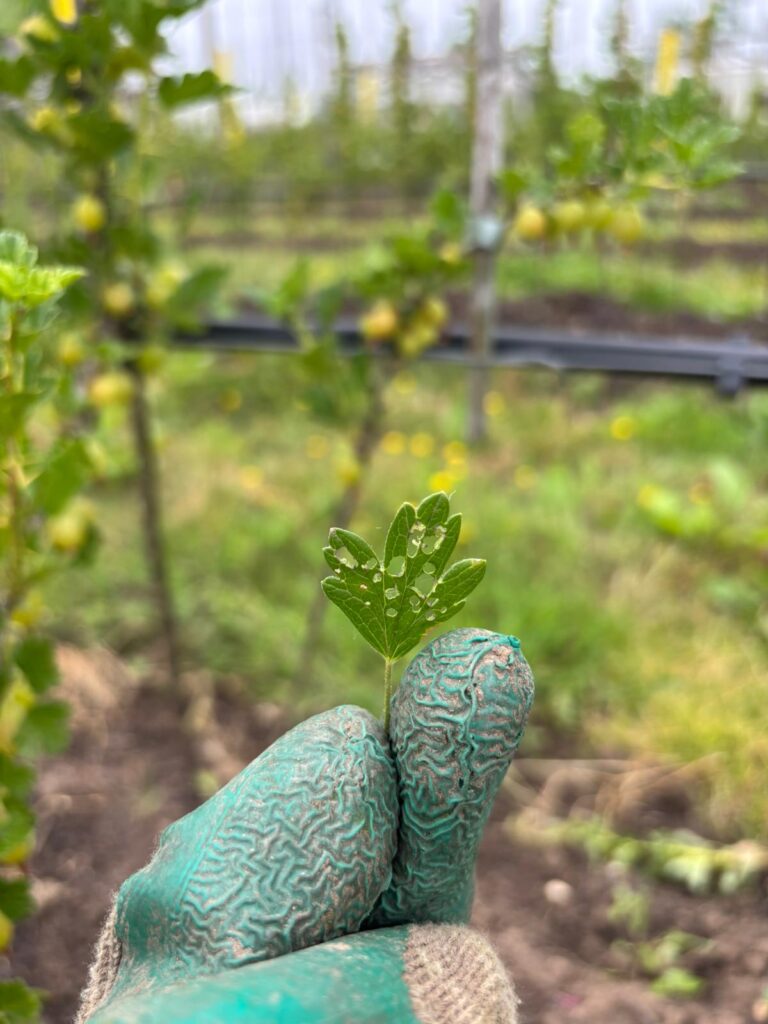
Staying at a farm in the Dutch countryside and spending the days taking care of it is a really effective method to reconnect with nature. I think that the task that has grounded me the most here has been killing the current worms on the gooseberry crops. It’s a bit ironic, and it’s not to say that it’s a task I enjoyed doing, but I found it impactful in a different way. The end goal of this is to reduce foliage damage so that the plant can ultimately have enough energy to both grow and produce more gooseberries. They don’t necessarily look the part, but those little creatures can destroy a lot if their population isn’t controlled in some way.
In conventional farms, this is achieved by the use of pesticides which kill a range of different pests and insects at the same time and have the capacity to greatly reduce or even eliminate their populations. Doing this job manually, by checking every plant, sometimes leaf by leaf creates a bond between the observer, the plant and the organisms that it’s hosting. Recognizing which worms act as pests and having to crash them one by one makes it kind of personal. There’s a deep awareness of what it is we’re killing and the reason behind it. Additionally, the inherent imperfection of performing the task manually is also maintaining a balance in this environment. The population is being kept small but not inexistent and other populations aren’t affected.
These worms are actually the larval stage of gooseberry sawflies and don’t really look like worms at all. They are green, they have legs, a big black head and their abdomen is covered in black dots. When they grow larger, specifically at their final larval stage they become white. Since they feed on the foliage, they leave behind traces that are clearly visible. Sometimes, it’s a half-eaten leaf, and sometimes it’s a leaf with multiple tiny holes. So, when we see that we know that at some point the worm was there. Sometimes it still is, sometimes it’s not and sometimes by turning the leaf around we find the eggs laid by the sawfly alongside the veins -they also have to be crashed. We learnt how resilient they can be; they survive in the soil for extended periods of time, and they can have three generations in the same year. It’s impossible to kill them all by hand, but that’s also the point.
While going through the plants and the leaves, it’s impossible not to notice all the other organisms living around. Spider webs between the wires, little frogs on the soil, (actual) worms and plenty of ladybugs. All these organisms play vital roles in the ecosystem, serving as mutualists that benefit the plants while also gaining advantages themselves. Spiders have the space to make their web and feed off of the flies that tend to surround the plants and by doing so, fewer flies are laying eggs there. The earthworms release nutrients for the plant by breaking down organic matter, while the plant roots stabilize the soil, providing the environment that the worms need to survive. And finally the ladybugs have a shelter from predators and space to lay their eggs, while they’re incidentally pollinating the plants. Pollen can stick to their body and legs and gets transferred around as they go about their day. It’s not only good that we’re not disturbing these populations, it’s also necessary for maintaining the ecosystem.
At the end of the day, even though we have blood (or in this case haemolymph) on our hands (or gloves), there’s a recognition that this is one of the best ways to do this. This is especially the case on a planet where a major percentage of the natural environment has been destroyed. So contributing to the conservation of an ecosystem, as small or as big as it may be, is still consequential.

Eating is an agricultural act
Olga, June 11 2025
Goedendag! My name is Olga, I’m 24 years olds and I’m volunteering five months here at Fruitweelde in The Netherlands. When I told everyone in my hometown (Madrid, Spain), that I was leaving for 5 months to work in the dutch countryside, it was definitely a surprise. But to me this kind of action is a natural way of living and makes a lot of sense.Since I was little I feel connected to nature. I remember being five years old, and in class our teacher explained the activity for that day: making personalized bookmarks with the flowers from the school. That bookmark turned into one of my most precious object.
I also remember family vacations visiting different parts from Spain and staying at campings, where we would spend the day exploring the mountains and collecting insects, rocks and all kinds of natural rest with my brother. This memories still make me nostalgic. So yeah, I might be from a big city, but that hasn’t stopped me from also appreciating and admiring a slower life. I guess all my influences have been crucial and led me to get involved here.
Fruitweelde was presented to me thanks to The European Solidarity Corps program, and when I read about it I decided to apply immediately. I never heard the term Biodynamic farming, but I fell in love with the idea of waking up here and seeing the beautiful landscape. Yes, we do wake up early everyday to work in the crops with a forecast most likely unpredictable, but we keep learning new things and cooperating. Additionally, we are not only building crops, but relationships between us, and with that exchanging points of view and perspectives that led us to learn about each other. It is also refreshing to see a way of production that treats and nurtures the land with respect, care and awareness. I values like this are fundamental especially nowadays, where consumption plays such a huge roll in our today’s society.
I feel very privileged to be able to experience something like this. I also understand that it might not be for everyone and you don’t have to be as radical as me. But taking the words from writer and farmer Wendell Berry: ‟Eating is an agricultural act” but also an ecological and political one. Writer Michael Pollan also points that –how and what we eat determines to a great extent the use we make of the world and what we become of it–.
That being said, just thinking what are you choosing to eat today impacts you. Food has culture, history and heritage that makes our living richer and definitely delicious.


Sustainable Weeding
Artemis, June 5 2025
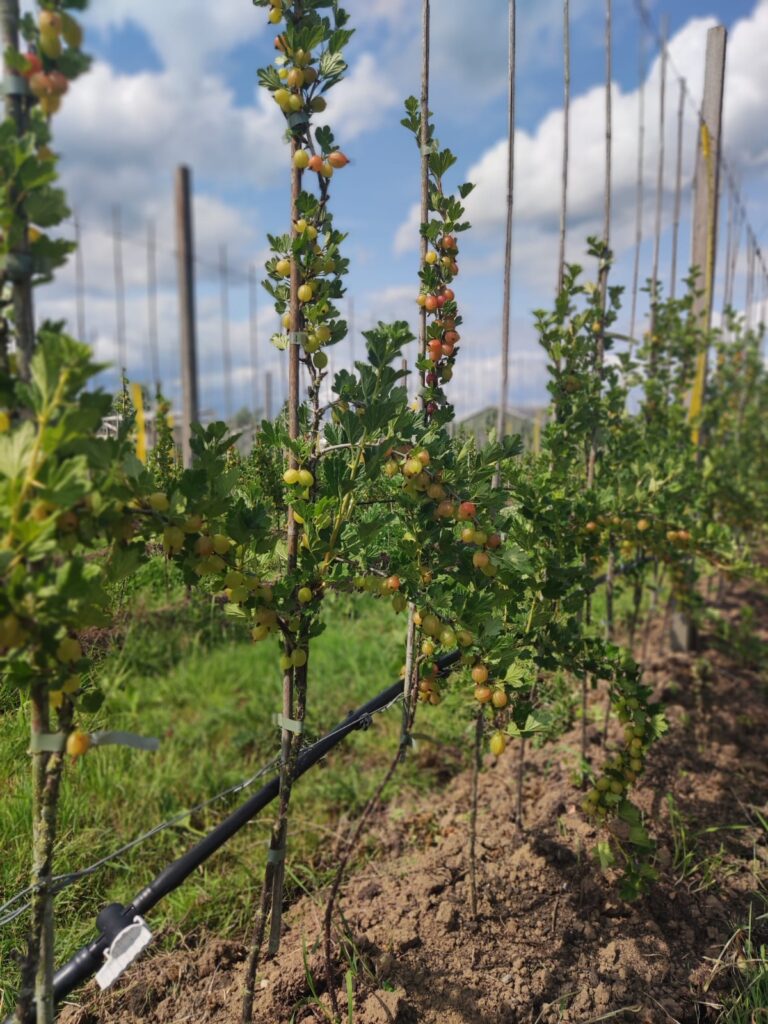
Before coming to the farm, I never had to wake up early for a physical activity. Somehow, this Monday, I found myself weeding grass at 8 am to help grow gooseberries – I had never even heard of these before. So, still half asleep, I learnt to differentiate between the berry stems and the weeds, the unwanted roots and the plant roots and started separating them.
This is important to do as weeds will compete with the gooseberry plants for nutrients and water from the soil. If they grow too big, they can even shade the plants and prevent the absorption of sunlight. Of course, the plants also need plenty of physical space to spread their roots and branches. Therefore, taking the weeds off completely, – and making sure to remove the roots so they don’t grow back – is essential. This way, the plants can grow as much as they can and will have the resources to produce more berries.
Most farms use herbicides to do this job. These are substances that either kill weeds or inhibit their growth. While they don’t target the crops, they have lasting effects on the environment and even on human health. They are most often applied in a large area at once by tractor sprayers. This does not only kill weeds but other kinds of flora as well that isn’t affecting the crops, both within the field and in the surrounding area. This practice fundamentally changes the ecosystem and can indirectly affect different animal populations such as birds and insects.
Additionally, herbicide residues remain in the soil and negatively affect the microbial richness. Bacteria and fungi found within the soil play an important role as they recycle nutrients and contribute to the degradation of organic material. When the herbicide concentrations are high, their diversity drops and over time, the soil can become less fertile.
On top of everything, long term herbicide exposure has been linked with a high risk of cancer. All this to highlight the importance of the reduction of the use of herbicides. There are a lot of alternative methods and sustainable practices, including some organic herbicides which break down over time. In Fruitweelde however, we like to do this manually, affecting the environment as little as possible and maintaining biodiversity.
The work can be hard, especially when dealing with grass. Its roots tend to expand everywhere, and they can be hard to pull out. But it’s very satisfying by the end, when you look back at all the progress that you made. And it’s especially rewarding knowing that you’re working with the ecosystem instead of against it.
Tips from Artemis if you want to read more about sustainable weeding:
